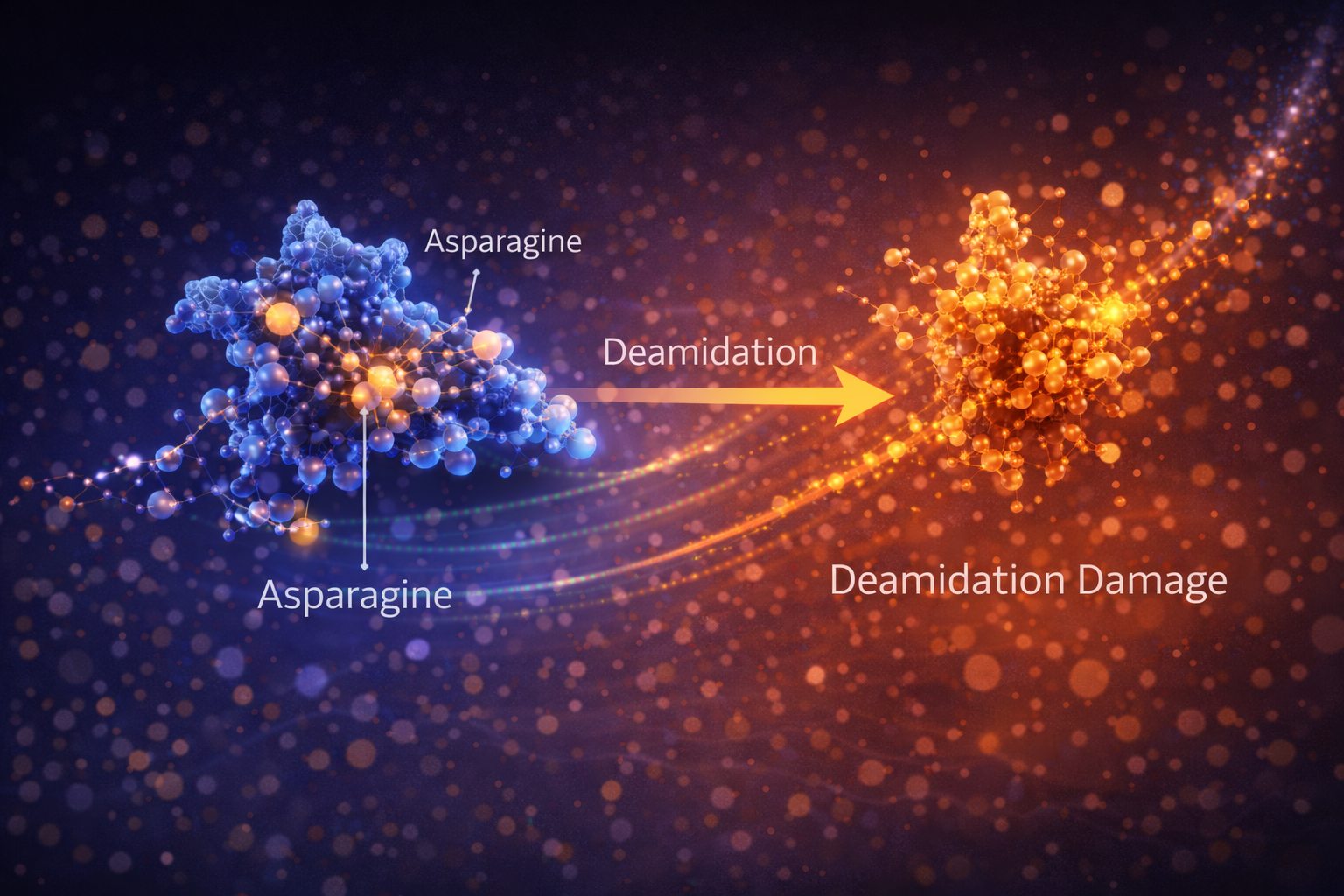
Protein deamidation is a time-dependent, chemically irreversible molecular process that accumulates progressively in biological systems.
Because of its cumulative nature, deamidation provides a robust molecular basis for measuring biological aging rate , rather than static age estimates.
The diagnostic system developed by Argeron Medical uses protein deamidation kinetics as the core biochemical signal to quantify how fast biological aging progresses over time.
Protein deamidation is a spontaneous chemical modification in which asparagine (Asn) or glutamine (Gln) residues are converted into acidic forms.
Key characteristics:
Once deamidation occurs, it cannot be reversed in vivo.
Aging is driven by irreversible cumulative biological damage, not transient fluctuations.
An ideal aging-rate biomarker must therefore:
Protein deamidation fulfills these criteria, making it uniquely suitable for rate-based aging measurement.
Unlike static biomarkers, deamidation follows predictable kinetic behavior.
By quantifying:
it becomes possible to calculate biological aging rate — the velocity at which molecular damage accumulates.
This transforms protein deamidation into a molecular clock, grounded in chemistry rather than statistical correlation.
Many aging assessments focus on DNA-based markers, particularly epigenetic modifications.
While informative, these markers have limitations when used for dynamic aging-rate measurement .
Key distinctions:
Protein-based biomarkers therefore provide a more stable substrate for longitudinal aging analysis.
Protein deamidation can be quantified with high precision using liquid chromatography–mass spectrometry (LC-MS).
LC-MS enables:
The Argeron diagnostic kit leverages LC-MS to generate a standardized aging-rate signal.
The measurement of protein deamidation — and thus biological aging rate — is achieved entirely through biochemical analysis.
Artificial intelligence:
Any AI-based analysis occurs after the diagnostic result has been produced and functions solely as optional decision support.
Because protein deamidation reflects cumulative molecular damage, aging-rate measurement enables:
This shifts aging assessment from correlative estimation to direct molecular measurement.
Protein deamidation does not estimate aging.
It measures how fast aging is happening.